Monday Apr 10, 2023
Baby David
A Reading Life, A Writing Life, with Sally Bayley
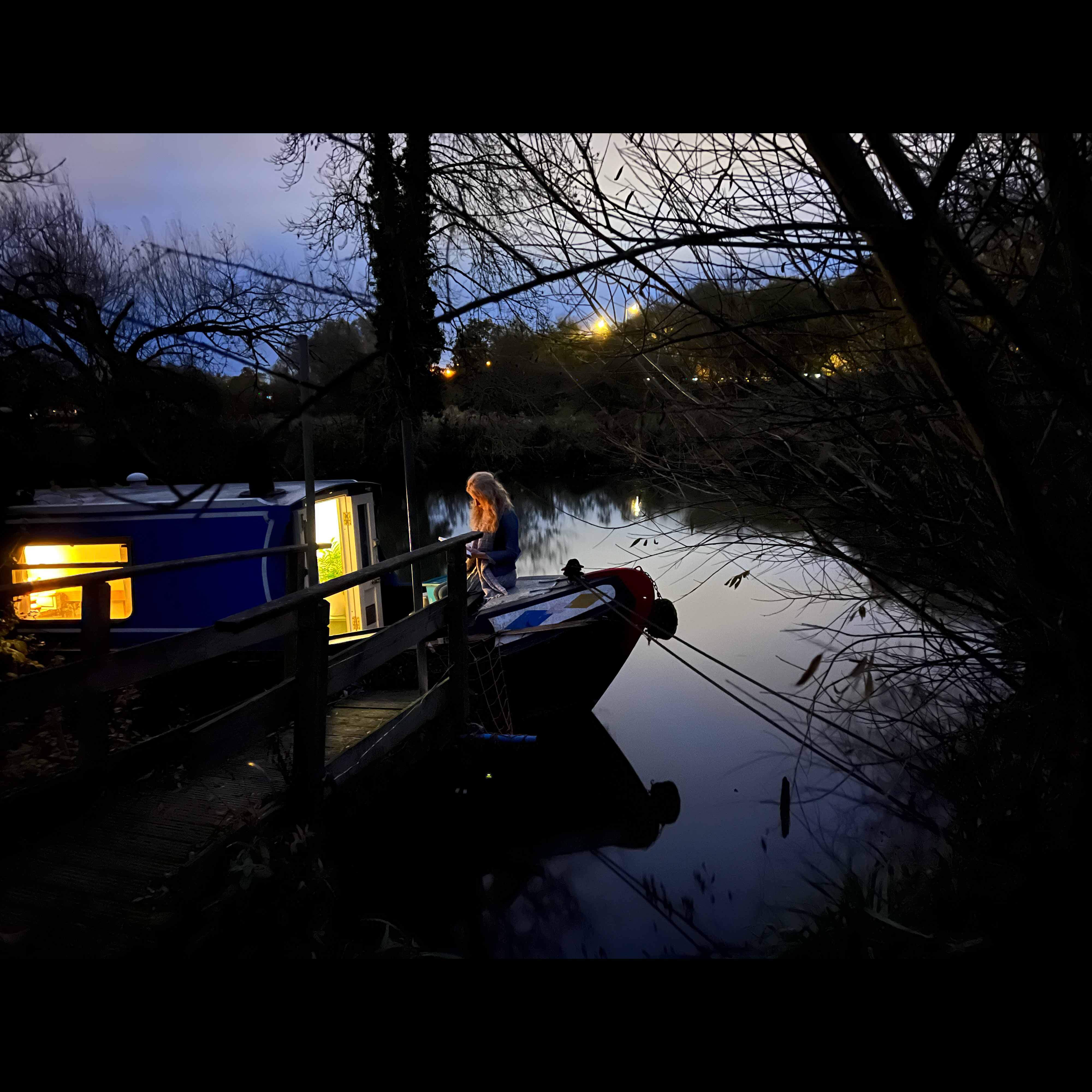
Acclaimed writer Sally Bayley lives on a narrowboat, surrounded by the sights and sounds of nature, sustained by reading and writing. In this series, she invites us into her life, showing us how books have the power to change your life. Sally has recently been diagnosed with an auto-immune disease, but this is not a misery memoir podcast; she shows us how literature and connection to nature can console and give courage and insight. The series is produced by Andrew Smith, James Bowen, Lucie Richter-Mahr, and Dylan Gwalia. To find out more about Sally please visit: https://sallybayley.com.
Listen on:





Episodes
Episodes


Wednesday Mar 29, 2023
Wednesday Mar 29, 2023
Sally does her washing on the narrowboat, and with spring in the air, her thoughts turn to the past. She reads from an old favourite, the children’s classic novel, The Wind in the Willows, and discusses its characters and themes with her friend from next door, Maeve Magnus, who is reading it for the first time and sees close parallels between the book and their own lives on the river. Sally recalls her fierce search for meaning and direction of her university days, and how she plunged into the writings of the American scholar Camille Paglia; then she reads an illuminating passage written by a former student, the writer, art critic and academic, Rebecca Birrell. Sally ends by reflecting on her desire for privacy and space, and the adoption of literary and artistic personae, reaching back to the masks worn by actors in ancient Greece.
The Wind in the Willows is a children's novel by the Scottish novelist Kenneth Grahame, first published in 1908. It details the story of Mole, Ratty, and Badger as they try to help the excitable, impetuous, swaggering, but hapless Mr Toad. The novel was based on bedtime stories which Grahame, a successful banker and financier, told his seven-year-old son. The book's impressionistic descriptions of the English countryside and its mythic search for moments of grace have made it an enduring read for adults as well as children; while the setting of the book partly drew on the author's experiences of living beside the River Thames, south of Oxford - not too far from where Sally and Maeve now live.
Grahame died in 1932 and lies buried in Oxford’s Holywell Cemetery.
Sexual Personae: Art and Decadence from Nefertiti to Emily Dickinson, which Sally read avidly at university, is a 1990 book about sexual decadence in Western literature and the visual arts by scholar Camille Paglia. The novel draws on the conflicts of Greek drama and demonstrates their continued relevance in its comprehensive study of Western art and literature, from Botticelli and Leonardo daVinci to Shakespeare, Goethe, Coleridge, Emily Brontë and Oscar Wilde.
This Dark Country: Women Artists, Still Life and Intimacy in the Early Twentieth Century by Dr Rebecca Birrell is published by Bloomsbury Circus. It is both biography and art critcism of 10 female artists, including Dora Carrington, Vanessa Bell and Gwen John. It was the Guardian Art Book of the Year and shortlisted for a number of other prestigious awards.
The producer of the podcast is Andrew Smith: https://www.fleetingyearfilms.com
The extra voice in this episode is Emma Fielding.
Thanks to everyone who has supported us so far. Special thanks go to Violet Henderson, Kris Dyer, and Maeve Magnus. If you would like to support us, please visit - https://gofund.me/d5bef397
Wednesday Feb 22, 2023
Wednesday Feb 22, 2023
In this episode, released on the anniversary of the invasion of Ukraine, Sally reads the works of great Ukrainian writers and poets of previous generations. Her thoughts turn to the novelist Joseph Conrad, who was born in a region which is now part of Ukraine. She reads passages from his masterpiece, Lord Jim, about the tangible presence of evil in the world. In a lighter vein, she reads an extract from her own fictional essay about the joys and freedoms of walking.
Further Reading
Sally’s fictional essay - on the theme of a childhood walk - is called ‘A Curvy Road is Better Than a Straight One.’ It was published in Where My Feet Fall, edited by Duncan Minshull, in March 2022, published by HarperCollins.
https://www.hive.co.uk/Product/Duncan-Minshull/Where-My-Feet-Fall--Going-for-a-Walk-in-Twenty-Stories/25944755
It can also be read here:
https://static1.squarespace.com/static/5f730ffd0bf1d6070e5deca8/t/62498d352ac7771421325dcf/1648987447229/Sally+Bayley.pdf
Taras Shevchenko (1814 –1861) was a poet, writer, artist, and intellectual, who advocated Ukrainian independence at a time when the Tsarist Russian Empire directly ruled the country. His works are considered to be the main foundation of modern Ukrainian literature, giving a dignity and literary heritage to the Ukrainian language. He also wrote in Russian (nine novellas, a diary, and an autobiography).
Shevchenko was convicted in 1847 of explicitly promoting the independence of Ukraine, writing poems in the Ukrainian language and ridiculing members of the Russian Imperial House.
Marie Bashkirtseff (1858 to 1884) was born into a Russian family near Poltava, in a region which is now in Ukraine, She moved to Paris to become an artist, creating a sizeable body of work in her short lifetime ,as well as becoming known as an intellectual. Her diary was posthumously published in 1887, only the second diary by a woman published in France to that date. It recounts her life, work and her relentless struggle with the tuberculosis which eventually killed her, aged 25. She wrote: "If I do not die young, I hope to live as great artist; but if I die young, I intend to have my journal, which cannot fail to be interesting, published." The diary made her famous in literary circles, being rapidly translated into English too, and has often been used as a model by other diarists, including Katherine Mansfield and Anais Nin.
Joseph Conrad was born in 1857 in Berdychiv, which was then part of the Russian Empire but is now in Ukraine. He was Polish in ethnicity; although the vast majority of the surrounding area's inhabitants were Ukrainians, almost all the countryside was owned by the Polish nobility. Conrad spent nearly 20 years of his life working as a sailor with the British and French merchant navies while nurturing ambitions to become a writer. Remarkably, he wrote some of the finest novels in the English language despite only becoming fluent in the language in his twenties.
Conrad published Lord Jim as a serial from October 1899 to November 1900. Its central character is a sailor who lives in disgrace and travels the world seeking redemption. The novel deals with existentialist themes, personal responsibility in an uncaring, cruel universe, and the nature of good and evil. Nostromo, a story of imperialist exploitation and revolt in South America, was published, again in instalments, in 1904.
The producer of the podcast is Andrew Smith: https://www.fleetingyearfilms.com
The extra voice in this episode is Emma Fielding.
Thanks to everyone who has supported us so far. Special thanks go to Violet Henderson, Kris Dyer, and Maeve Magnus.
If you would like to support us, please visit - https://gofund.me/d5bef397
Monday Feb 06, 2023
Monday Feb 06, 2023
In this special, double-length episode, Sally leaves her boat to seek refuge at a friend’s house on another island in Oxford, as the rains have flooded the meadow of her narrowboat community. Returning to the boat as the waters subside, she reads a poem by Elizabeth Bishop, then settles down to study a collection of essays by Will Self. The essays lead Sally to reread a chilling short story by the surrealist writer Franz Kafka - and a striking phrase reminds her of one of her favourite sentences in all of modernist literature. Sally’s musings are interrupted by a visitation from her seven-year-old neighbour, Maeve Magnus. They discuss why we read, the value of sad stories, and reminisce about trips to a local café for communal reading and ice cream. Sally's reading makes her think of her own medical treatment, and she announces plans for the future of the podcast.
Further Reading:
Elizabeth Bishop (1911 –1979) was an American poet and short-story writer. She was effectively orphaned in early childhood and suffered all her life from ill health. In reaction to the then-prevalent confessional style of American poetry, her works reveal very little of her private life. She published the poem Crusoe in England in her collection, Geography III, in 1979.
In the poem, Crusoe has left his famous desert island to return to his home island, but ironically feels more displaced and lonely than when he was a castaway.
Robinson Crusoe is of course the hero of Daniel Defoe’s 1719 eponymous book, often claimed to be the first novel published in English. It’s probably based at least in part on the story of the real-life castaway Alexander Selkirk, and was a huge success in its day, with many readers initially fooled into believing that it was a work of factual autobiography.
Emily Dickinson (1830 - 1886) lived most of her life in virtual seclusion. She wrote deeply private, radically experimental poems, which she hid in her room and were never published in her lifetime. After her death, her sister found her cache of poems and she’s now considered one of the greatest poets in the English language
The Dickinson poem which Sally riffs on was published posthumously in 1891 in a collection entitled Poems, Series 2. The poem seems to celebrate her position in life, estranged from society and fame, finding communality with similar outsider figures. It reads in full:
I’m Nobody! Who are you?Are you – Nobody – too?Then there’s a pair of us!Don't tell! they'd advertise – you know!
How dreary – to be – Somebody!How public – like a Frog –To tell one’s name – the livelong June –To an admiring Bog!
Will Self’s collection of essays, entitled Why Read: Selected Writings 2001 – 2021, was published in November 2022 by Grove Press UK. It’s packed with advice for readers - what to read, how to read, and discusses why we read; it also features insights into some of his favourite writers, including Virginia Woolf, Franz Kafka, George Orwell, Joseph Conrad, W.G. Sebald and William S Burroughs.
A Country Doctor was written in 1917 by the German-speaking Czech writer Franz Kafka. Kafka was born in Prague in 1883 and died in 1924. His best known works are The Metamorphosis, The Trial and The Castle; his writings are frequently surrealistic, bizarre and unsettling, exploring themes of existentialism, absurdity, alienation and guilt.
To The Lighthouse was written by Virginia Woolf in 1927 and is perhaps her most highly regarded and radically innovative novel. It deals with loss, subjectivity, the encroachments and damages of time, the nature of art and the problems of perception. The sentence Sally discusses is a pivotal moment in the middle section of the book, as Woolf speeds up her account of her characters' lives as if they are caught in a fast-forward film; so the death of Mrs Ramsey, a central character, is dealt with in one almost-throwaway sentence.
Maeve Magnus is reading Michael Morpurgo’s collection of short stories, Best Mates, published in 2015, which includes the story The Silver Swan. Beware spoilers!
Ronald Stuart Thomas (1913 - 2000), published as R. S. Thomas, was a Welsh poet and priest. Throughout his life, he moved to increasingly isolated parishes to escape what he considered to be the materialism of the modern world and the creeping influence of English culture. Throughout his life, he wrote poems of breathtaking spirituality and insight, combining a love for the Welsh landscape with a grittily realistic portrayal of the people who inhabited the landscape.
The Sick Rose is a "poem of experience" which William Blake published in his extraordinary collection, Songs of Innocence and of Experience. Blake (1757 – 1827) was born into the London working classes and worked as a printmaker, set apart from the literary establishment of the time, composing, creating, illustrating and printing his works himself. A visionary and wholly unique figure, considered by some to be verging on the insane, he was largely unrecognised in his life, but is now seen as a trail-blazing figure in the Romantic movement, celebrated both for his poetry and his visual art.
The producer of the podcast is Andrew Smith: https://www.fleetingyearfilms.com
The extra voice in this episode is Emma Fielding.
We are currently raising funds to pay to keep the podcast going. If you would like to support us, please visit - https://gofund.me/d5bef397
Thanks to everyone who has supported us so far. Special thanks go to Violet Henderson, Kris Dyer, and Maeve Magnus, who makes her debut appearance in this episode.
Tuesday Jan 24, 2023
Tuesday Jan 24, 2023
Sally wakes up at dawn and thinks about the book she's currently writing – Pond Life, a fictional biography of two women who live on the south coast of Britain in the years after the Second World War. The book addresses themes of loneliness, disconnection and the consolations and snares of film, art and the imagination. Sally consults her own memorandum, a note to herself and the reader, about the composition of the book; and she reflects on the need for calm, away from the distraction of screens, in the creative process.
Further Reading:
Pond Life will be Sally’s fourth book in her series which follow autobiographical themes and which she prefers to call “anti-memoirs”. The other books are Girl With Dove, published by William Collins in 2018. No Boys Play Here in 2022, and The Green Lady, which will be published this summer. You can learn more about her writing here:
https://sallybayley.com/books
Brief Encounter is a 1945 British film directed by David Lean from a screenplay by Noël Coward, based on his 1936 one-act play Still Life. Starring Celia Johnson, Trevor Howard, Stanley Holloway, and Joyce Carey, it and was hailed as a breakthrough in modern realism. It is now widely seen as one of the greatest films of all time, with its depiction of frustrated love in a repressed and class-ridden society. It features Piano Concerto No.2, composed by Sergei Rachmaninoff between June 1900 and April 1901 during a period of creative release, following some years of depression and a devastating writer’s block.
Samuel Taylor Coleridge’s Biographia Literaria was published in 1817 in two volumes. Coleridge was a key figure in the introduction of the discipline of psychology into British intellectual life, and his work outlines his theories on imagination, the creative mind, perception, and poetry. He writes:
The primary IMAGINATION I hold to be the living Power and prime Agent of all human Perception, and as a repetition in the finite mind of the eternal act of creation in the infinite I AM.
Mr. Bennett and Mrs. Brown is an essay by Virginia Woolf published in 1924. A furious rebuttal of Arnold Bennett, who had written a critical review of her book Jacob’s Room, it rejects the writers of the Edwardian generation and announces the arrival of modernism. Referring to the revolutionary exhibition by Roger Fry, Manet and the Post-Impressionists, she declares: "in or about December, 1910, human character changed". Modernism, she says, has changed "religion, conduct, politics, and literature"; criticising contemporary ideas of realism, she writes: “What is reality? And who are the judges of reality?"
The producer of the podcast is Andrew Smith: https://www.fleetingyearfilms.com
The extra voice in this episode is Emma Fielding.
We are currently raising funds to pay to keep the podcast going. If you would like to support us, please visit - https://gofund.me/d5bef397
Thanks to everyone who has supported us so far. Special thanks go to Violet Henderson, Kris Dyer, and Maeve Magnus.
Tuesday Jan 17, 2023
Tuesday Jan 17, 2023
Sally takes time off from trying to unblock her sink to conduct a creative writing lesson with her student, Evelyn. They discuss a single sentence in a short story written by Katherine Mansfield, the modernist writer who died 100 years ago this month. After Evelyn leaves, Sally settles down to read Mansfield’s diaries, immersing herself in her scribblings both funny and profound.
Further Reading:
Katherine Mansfield was a writer, essayist and journalist who primarily wrote short stories and poems which explored existential anxiety and issues of sexuality and class.
She was born in New Zealand in 1888, travelling to Britain aged 19 with the initial intention of becoming a professional musician. She became a well-known figure in bohemian London, befriending members of the Bloomsbury Group, publishing short stories in literary magazines and hanging around with writers such as DH Lawrence. She became a close friend and rival of Virgina Woolf; Woolf said of her, “I was jealous of her writing. The only writing I have ever been jealous of.” Some critics consider Mansfield to have been a major influence on Woolf’s work.
Like Woolf, Mansfield suffered from ill-health. She was left devastated by the death of her brother Leslie Beauchamp in France in 1915, killed by a faulty hand grenade. She wrote in her diary: “Yes, though he is lying in the middle of a little wood in France and I am still walking upright, and feeling the sun and the wind from the sea, I am just as much dead as he is”.
She died aged 34 of pulmonary tuberculosis, with much of her work unpublished. Two volumes of her short stories (The Dove's Nest in 1923, and Something Childish in 1924); a volume of poems; The Aloe; Novels and Novelists; and collections of her letters and journals were all published posthumously. The story Sally and Evelyn discuss, The Garden Party, was published in 1922.
Jacob’s Room is a novel published by Virginia Woolf in 1922, the same year Mansfield published The Garden Party and the year before Mansfield’s death. It tells the story of Jacob who, like Woolf’s brother-in-law and Katherine Mansfield’s brother, was killed in the First World War. In a radically experimental form, Jacob’s story is told almost entirely through the recollections of those who knew him. Jacob keeps an old sheep skull in his room, a classic memento mori symbol.
Middlemarch, A Study of Provincial Life, is one of the most famous novels in the English language. Published in instalments in 1871 and 1872, it was written by Mary Anne Evans under the pseudonym George Eliot. Although Virginia Woolf described it as "the magnificent book that, which with all its imperfections, is one of the few English novels written for grown-up people”, she was one of its few fans at the time; the novel was little read and was underappreciated until at least the middle of the 20th century.
The book follows the stories of a vast canvas of characters in a town and surrounding villages, with at least four main plots and many other narrative strands, which intertwine to create a complex whole, which often confounds the reader’s first reactions. The American fiction writer Michael Gorra has written of Middlemarch: “If you really read this novel, you will learn about yourself; if you listen to her, if you let her sentences penetrate, you will find out things about yourself that you didn’t and maybe don’t even want to know. Each page is a lesson in how to be honest with yourself.”
The producer of the podcast is Andrew Smith: https://www.fleetingyearfilms.com
The extra voice in this episode is Emma Fielding.
We are currently raising funds to pay to keep the podcast going. If you would like to support us, please visit - https://gofund.me/d5bef397
Thanks to everyone who has supported us so far. Special thanks go to Violet Henderson, Kris Dyer, and Maeve Magnus.
Tuesday Jan 10, 2023
Tuesday Jan 10, 2023
Sally takes a trip on her shiny blue electric scooter to Oxford Public Library, where she picks up a novel by the iconic British modernist writer Jean Rhys. After a disturbing experience at the hospital, she seeks refuge in Rhys’ existentialist narrative of rootless but indomitable women, who eke out a living on the margins of society while searching for love, beauty and a sense of belonging.
Further Reading:
Jean Rhys was born in 1890 and brought up on the Caribbean island of Dominica. She was sent to England to further her education at the age of 16, but was continually mocked for her accent and her foreign birth. Unable to become an actress, she became a chorus girl, and, like many of her protagonists, earned a precarious living travelling around provincial England and the poorer parts of London. From the 1920s onwards, Rhys produced a string of short stories and novels based on her experiences, featuring outsider figures often dependent on alcohol, living hand-to-mouth, with no fixed income or permanent relationships. Rhys has become recognised as a leading modernist writer, her stories treasured for their interiority, experimental qualities and stream-of-consciousness techniques. She published Voyage in the Dark, the novel which Sally reads, in 1934.
The Second World War seemed to mark the end of her writing career and she disappeared from public view; it was even reported that she was dead. After a quarter of a decade, she re-emerged in her seventies to publish Wide Sargasso Sea. The novel is a revolutionary re-imagining of Charlotte Bronte’s 1847 novel Jane Eyre, telling the story from the perspective of Bertha Mason, Mr Rochester’s so-called “madwoman in the attic”. Rhys re-writes the character as a woman sold into marriage, exploited, tortured and incarcerated. An exposure of racial and sexual exploitation, the novel has been widely hailed as a post-colonial and feminist masterpiece.
In her first memoir, Girl With Dove, Sally describes how Jane Eyre was a pivotal book for her as she grew up. You can find out more about Sally’s own books here: https://sallybayley.com/
When Sally calls her visit to the hospital “Kafkaesque”, she is of course referring to Franz Kafka, the German-speaking author born in Prague in 1883, now seen as one of the most important writers of the 20th century. His works explored the plight of individuals trapped in strange, often surreal situations and nightmarishly complex bureaucratic systems. The term “Kafkaesque” has entered the English language and is often used to describe an alienating, illogical or absurd experience. Kafka died in obscurity in 1924 and his works only became famous after the Second World War.
The producer of the podcast is Andrew Smith: https://www.fleetingyearfilms.com
The extra voice in this episode is Emma Fielding, and the music is by Simon Turner.
We are currently raising funds to pay to keep the podcast going. If you would like to support us, please visit - https://gofund.me/d5bef397
Thanks to everyone who has supported us so far. Special thanks go to Violet Henderson, Kris Dyer, and Maeve Magnus.
Tuesday Jan 03, 2023
Tuesday Jan 03, 2023
Temperatures on the narrowboat dip below zero, so Sally takes the advice of Virginia Woolf and stays in bed to read poetry. She immerses herself in The Child’s Story, by the Oxford writer Elizabeth Jennings, a poem about the fear and the potential of love. Sally reflects on the connectivity between learning, teaching and love, and the regenerative possibilities of a New Year.
Further Reading:
Elizabeth Jennings was born in 1926 and studied at St Anne’s College, Oxford. She lived in the city for the rest of her life, becoming a familiar sight in local cafes where she wrote poems and chatted to the other patrons. She wrote more than 20 books of poetry throughout a very difficult lifetime, which often saw her struggling with depression and doubt. Her poetry collections Recoveries (1964) and The Mind Has Mountains (1966) dealt with a nervous breakdown and its aftermath.
Jennings was initially identified with “the Movement”, a group of poets including Philip Larkin and Thom Gunn, but she increasingly became recognised for her own, very individual voice. Her poetry, described as her “outlet for a tumultuous inner life”, became very popular at the end of her life, even as she fell deeper into poverty; the tabloid newspapers gave her the unkind nickname “the bag lady of the sonnets”.
Jennings, who was a lifelong Catholic, once said: “Sometimes I feel that an act of the imagination is more use than an act of faith.” She died in 2001.
In 2018, the American poet Dana Gioia wrote of Jennings: "Despite her worldly failures, her artistic career was a steady course of achievement. Jennings ranks among the finest British poets of the second half of the twentieth century. She is also England’s best Catholic poet since Gerard Manley Hopkins.”
You can find The Child’s Story here:
https://www.pnreview.co.uk/cgi-bin/scribe?item_id=5801
Sally previously spoke about Virginia Woolf’s 1926 essay, On Being Ill, in the first episode of this podcast. Woolf prescribed poetry for those who were feeling ill; she suffered from ill health and depression throughout her life. You can find the essay here:
https://thenewcriterion1926.files.wordpress.com/2014/12/woolf-on-being-ill.pdf
Jack Frost is a figure of myth and folklore who may originate in Anglo Saxon and Norse winter customs. He's traditionally said to leave frosty, fern-like patterns on windows on cold winter mornings. In the modern world, window frost has become far less commonly seen because of double-glazing.
Hannah Flagg-Gould's 19th century children's poem "The Frost" personifies him as a figure creating beautiful ice paintings on windows but, upset at the lack of gifts, uses the cold to break and ruin things.
https://www.storyberries.com/poems-for-kids-the-frost-by-hannah-flagg-gould/
The producer of the podcast is Andrew Smith: https://www.fleetingyearfilms.com
The extra voice in this episode is Emma Fielding
We are currently raising funds to pay to keep the podcast going. If you would like to support us, please visit - https://gofund.me/d5bef397
Thanks to everyone who has supported us so far. Special thanks go to Violet Henderson, Kris Dyer, and Maeve Magnus.
Tuesday Dec 27, 2022
Tuesday Dec 27, 2022
On a cold boat, Sally is warmed by her fire, the sound of her neighbours, and the cathartic practice of “speaking in tongues”, a technique she learned as a very young child from her aunt, who ran an all-female Christian charismatic group and would suddenly launch into these emotional outbursts. She reflects on how this practice may express the longings of the subconscious, and may have influenced her writing. Then she corrects the proofs of her next book, The Green Lady, the third in her series of “coming-of-age” memoirs, or anti-memoirs.
Further Reading
Sally’s first book in her cycle of childhood memoirs (she prefers the term “anti-memoirs”) is Girl With Dove, in which we are introduced to her granny, her mother, and her aunt, who brought the practice of “speaking in tongues” to the family. The book can be found here:
https://www.amazon.co.uk/Girl-Dove-Life-Built-Books/dp/0008226857
Sally’s cycle of books, Girl With Dove, No Boys Play Here, and the forthcoming The Green Lady, form a coming-of-age narrative. Coming-of-age stories, which usually follow the narrator from childhood or teenage years to adulthood, form a very significant branch of literature, with examples including Jane Eyre by Charlotte Bronte, many of Charles Dickens’ novels (Oliver Twist, Great Expectations, David Copperfield), The Adventures of Huckleberry Finn by Mark Twain, Emma by Jane Austen, The Catcher in the Rye by JD Salinger and White Teeth by Zadie Smith.
Speaking in tongues, also known as glossolalia, is a practice in which people utter words or sounds, often thought by believers to be languages unknown to the speaker. It’s seen as a divine language and sign of the inspiration of the Holy Spirit; a practice going back to the apostles at Pentecost, as related in the Acts of the Apostles. It’s a prominent feature of worship by Pentecostal and charistmatic Christian groups, such as the one run by Sally’s aunt.
Catharsis, used in this sense for the first time by Aristotle, is the purification and purgation of emotions through tragedy, or any extreme emotional state that results in release, renewal and restoration. It can also be related to the idea of expressing buried trauma, thereby easing the burden.
Genius Loci was a phrase originally used by the Romans to denote a literal “spirit of place”, a presiding divinity who inhabited a site and gave it meaning. Writers of the 18th century, such as Alexander Pope and Dr Johnson, developed it as the more secular idea that a location has a distinctive and palpable atmosphere; then the Romantic writers developed the quasi-spiritual sense that a place can have profound significance and meaning for us. Perhaps the most influential work in developing this idea is a set of five poems, written by William Wordsworth and included in the second volume of the Lyrical Ballads collection published in 1800, which he grouped under the rubric “Poems on the Naming of Places”. He explained: “Many places will be found unnamed or of unknown names, where little Incidents will have occurred, or feelings been experienced, which will have given to such places a private and peculiar interest. From a wish to give some sort of record to such Incidents or renew the gratification of such Feelings, Names have been given to Places by the Author and some of his Friends, and the following Poems written in consequence.” The poems can be read here:
https://en.wikisource.org/wiki/Lyrical_Ballads_(1800)/Volume_2/Poems_on_the_Naming_of_Places
The producer of the podcast is Andrew Smith: https://www.fleetingyearfilms.com
The extra voice in this episode is Emma Fielding and the music is by Simon Turner
We are currently raising funds to pay to keep the podcast going. If you would like to support us, please visit - https://gofund.me/d5bef397
Thanks to everyone who has supported us so far. Special thanks go to Violet Henderson, Kris Dyer, and Maeve Magnus.
A Reading Life, A Writing Life
Each episode of this podcast is accompanied with notes and tips for further reading. These can be found in the shownotes accompanying each episode.
Our thanks goes out to everyone who has supported Sally and her podcast so far. Your generosity has enabled us to launch the series. To find out more, or to support the on-going producton of the podcast, please visit https://gofund.me/d5bef397
To find out more about Sally Bayley please visit her website at https://sallybayley.com/
Thank you!