Tuesday Dec 20, 2022
These Words Will Not Wait
A Reading Life, A Writing Life, with Sally Bayley
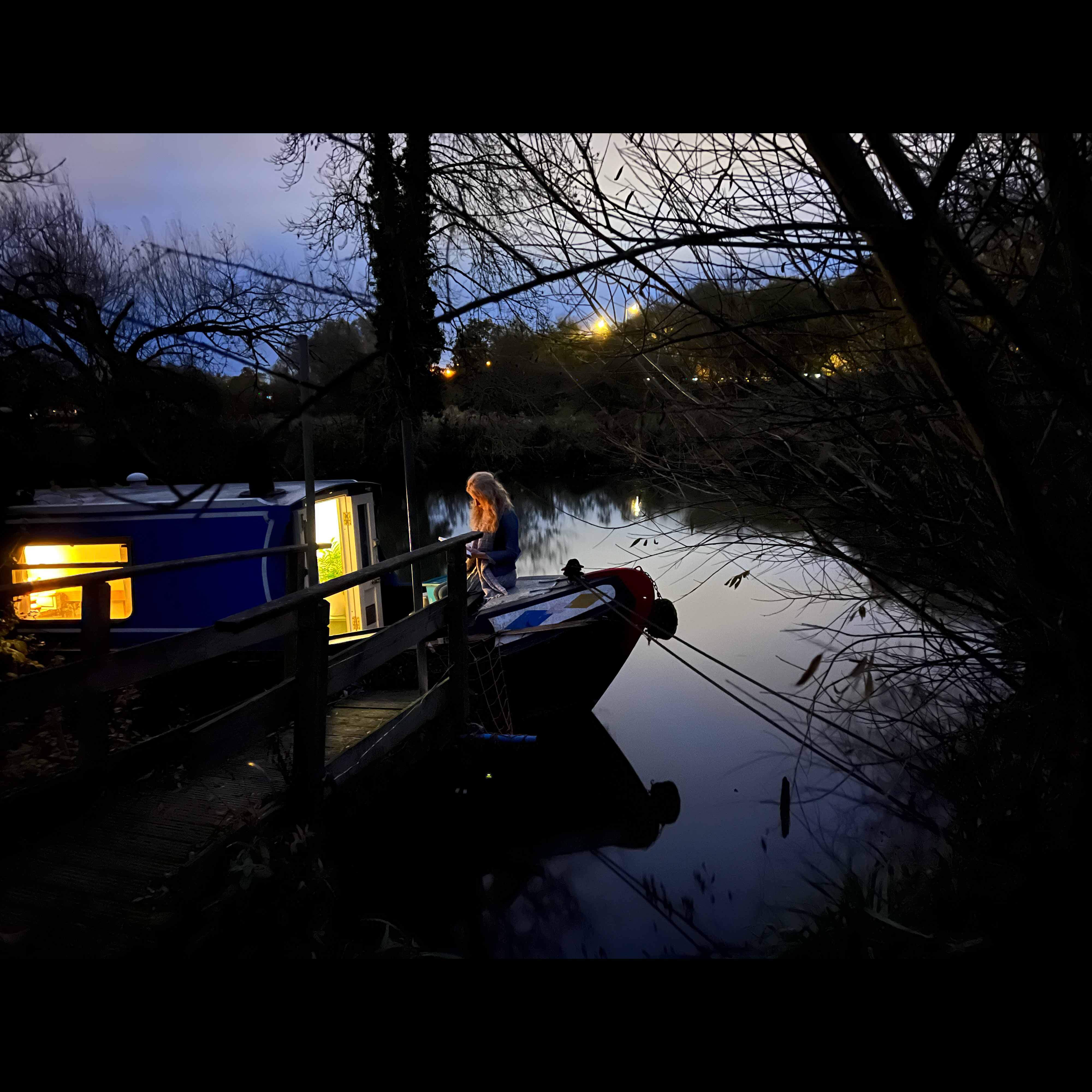
Acclaimed writer Sally Bayley lives on a narrowboat, surrounded by the sights and sounds of nature, sustained by reading and writing. In this series, she invites us into her life, showing us how books have the power to change your life. Sally has recently been diagnosed with an auto-immune disease, but this is not a misery memoir podcast; she shows us how literature and connection to nature can console and give courage and insight. The series is produced by Andrew Smith, James Bowen, Lucie Richter-Mahr, and Dylan Gwalia. To find out more about Sally please visit: https://sallybayley.com.
Listen on:





Episodes
Episodes


Tuesday Dec 13, 2022
Tuesday Dec 13, 2022
Sally takes a swim in the river after a few days’ absence from the boat, reflecting on how her natural surroundings fuel her writing. Her thoughts turn to her mother, who loved music; and she plays a song by Nina Simone, which Sally has often used as a teaching aid in her creative writing classes. It’s an elegiac song, and Sally ponders how songs can help us unpick the difficult narratives of our own lives. At the end of the episode, Sally gets bad news about Philip, an old friend and student. She reaches for a passage from Shakespeare’s The Tempest, an enraptured speech about music and the beauty of nature, and dedicates it to Philip in the final hours of his life.
Further Reading
The passage which Sally reads at the opening and ending of the episode is a rhapsodic speech by Caliban in Act 3, Scene 2 of Shakespeare’s The Tempest. Caliban is the original owner of the island, having had it bequeathed to him by his mother Sycorax; but Prospero, the Duke of Milan and a magus, has taken over the isle, and enslaved Caliban. Despite his servitude and the brutality of his treatment, Caliban shows he is poetically attuned to the enchantments of the island. Many of the phrases and images in this speech link us to Prospero’s famous reflections in Act 4 Scene 1, on the beauty and the transience of life and the inevitability of death: “our revels now are ended.”
Sally’s mother is a central character in her critically praised memoir (although Sally prefers the term “anti-memoir”) Girl With Dove, published by William Collins. You can find out more about her writing on Sally’s website:
https://sallybayley.com/
Nina Simone was an American singer, songwriter, pianist, and civil rights activist, who recorded more than 40 albums between 1958 and 1974. The song Stars, which Sally analyses, was written and released by Janis Ian in 1974. Nina Simone covered it on the album Let It Be Me in 1987 and sang it live at the Montreux Jazz Festival in 1976.
The melancholy of the live performance reflects Simone’s mourning for the passage of time, the fate of the anti-racism aspirations of the 1960s civil rights movement, and her own decline in popularity and stardom. The song can be found here:
https://open.spotify.com/track/1OXBfwBYtj2AAKi6jom1qT#login
This episode is dedicated to Professor Philip J. Stewart, who passed away shortly after it was recorded. Philip was a remarkable polymath who worked across the arts and sciences; with characteristic modesty, he described himself as a “Jack of all trades and master of none”. He studied Arabic and in the 1960s had a brief career as an Arabist, translating a novel by Nobel Prize winning author Naguib Mahfouz. He then took a second degree in forestry and worked in forest conservation and erosion control in Algeria, before teaching ecology in Oxford and writing widely on topics from chemistry and astronomy to music. When he retired, he dedicated himself to literature, writing a book about ten poets who lived or wrote on Boars Hill where he lived – poets such as Robert Graves, Matthew Arnold and John Masefield - called Oxford's Parnassus (Bothie Books, 2021).
Since this episode was recorded, Sally has heard from Philip’s daughter that she did indeed read Caliban’s speech to him before he passed away
The producer of the podcast is Andrew Smith: https://www.fleetingyearfilms.com
The extra voice in this episode is Emma Fielding and the beautiful piano tracks used in the episode are written and performed by Paul Clarke
We are currently raising funds to pay to keep the podcast going. If you would like to support us, please visit - https://gofund.me/d5bef397
Thanks to everyone who has supported us so far. Special thanks go to Violet Henderson, Kris Dyer, and Lady Ronia.
Wednesday Dec 07, 2022
Wednesday Dec 07, 2022
A robin visits Sally’s boat, and she reflects on the importance of quietness and concentration in the creative process. Inspecting a patch of the meadow which she shares with other boat owners, she thinks of the pioneering naturalist Henry David Thoreau, who also escaped urban living in search of the natural life. Meanwhile, podcast producer Andrew wanders through the woods in search of Sally’s boat and together they discuss a big question in literature; what is the appeal of tragedy, why do we find pleasure in sad stories and sad songs? Sally discusses how tragic literature can help prepare us for the worst; the discussion turns to her own recent diagnosis of an auto-immune disease and the effect it has had on her life. Sally shares with us how a lifetime of reading and writing has helped fortify her and given her courage.
Further Reading
The “homework” Sally sets for Andrew is A.J. Nuttall’s book, Why Does Tragedy Give Pleasure? published by Oxford University Press in 2002. It’s an introduction to the major themes of tragedy, from Greek drama to modern literature, discussing how tragedy can relate to our lives today. It deals with the question of how literature might help us deal with loss, bereavement and the transience and frequent cruelty of human life. It can be found here:
https://www.amazon.co.uk/Why-Does-Tragedy-Give-Pleasure/dp/0198187661
When Sally says she feels “very Henry David Thoreau”, she’s referring to the 19th century American naturalist, poet and philosopher who retreated from the modern world to live at Walden Pond in 1845. Thoreau built a log hut, living off wild fruits and vegetables, spending his time observing and recording in his journals the sights and sounds of nature, as well as meditating. In 1854, he wrote his most famous work, “Walden”, which secured his reputation as a forerunner of the modern ecologist and environmentalist movement. As Sally points out, though, Thoreau hadn’t exactly isolated himself; Walden Pond was only a few miles from his family home and he frequently entertained visitors. In an oft-quoted passage from “Walden”, Thoreau wrote: “I went to the woods because I wished to live deliberately, to front only the essential facts of life, and see if I could not learn what it had to teach, and not, when I came to die, discover that I had not lived. … I wanted to live deep and suck out all the marrow of life.”
You can find his book “Walden” here:
https://www.gutenberg.org/files/205/205-h/205-h.htm
In this episode, we briefly refer to the events of Sally’s childhood and the way in which books became her refuge, her salvation, and her way of understanding the world. Sally writes about her childhood, and how she created “a life built by books”, in her critically praised memoirs (although Sally prefers the term “anti-memoirs”) Girl With Dove and No Boys Play Here, published by William Collins. You can find out more about the books on Sally’s website:
https://sallybayley.com/
The producer of the podcast is Andrew Smith: https://www.fleetingyearfilms.com
The extra voice in this episode is Emma Fielding and the beautiful piano track used in the episode is by Paul Clarke
We are currently raising funds to pay to keep the podcast going. If you would like to support us, please visit - https://gofund.me/d5bef397
Thanks to everyone who has supported us so far. Special thanks go to Violet Henderson, Kris Dyer, and Lady Ronia.
Friday Dec 02, 2022
Friday Dec 02, 2022
Sally invites us into her life on the boat, a life lived in close connection to nature, powered by sunlight from her solar panels. We hear how a water pump works, and witness a daddy long legs making its slow way across a rainy porthole. Sally is reading the diaries and journals of Virgina Woolf, a modernist “stream-of-consciousness” writer, who intensively recorded her own thoughts and observations, transforming them into enduring art. Sally responds to the events of the day by writing her own piece of poetic prose, on how we think, and who we really are.
Further Reading:
Sally talks about a classic short story by Virginia Woolf, The Death of a Moth. In this story, Woolf’s narrator watches the world outside through her window, fascinated by the energy that comes to her from the natural world, “rolling in from the fields and the down beyond … in at the open window and driving its way through so many narrow and intricate corridors in my own brain and in those of other human beings”. She watches a moth crawling across the window, impelled by the same natural energy; but she also realises that the moth is dying.
The story was published posthumously, in 1942, the year after Woolf’s death:
https://www.sanjuan.edu/cms/lib8/CA01902727/Centricity/Domain/3981/Death%20of%20A%20Moth-Virginia%20Woolf%20copy.pdf
Sally also quotes from an essay by Woolf, called On Being Ill, in which Woolf meditates on her changed consciousness and perceptions during her frequent bouts of illness. Woolf thinks about Hamlet, Shakespeare’s most famous tragic protagonist, who has inspired thousands of books of criticism and analysis which take contradictory positions on what is known as “The Hamlet Problem”: who is Hamlet, and what compels him to act and feel the way he does? It’s one of the most elusive and important questions in all of literature; and it’s a question we can ask about ourselves and others.
You can read Woolf's essay, published in 1926, here:
https://thenewcriterion1926.files.wordpress.com/2014/12/woolf-on-being-ill.pdf
When Sally quotes "To be or not to be", this is of course a reference to Hamlet's third soliloquy, in Act 3, Scene 2, perhaps the most famous line in all of English literature, as Hamlet debates the biggest questions of all; life or death, thinking or acting, becoming or "letting be".
Sally also quotes the phrase, "The heart of light, the silence." This is from T.S. Eliot's modernist masterpiece The Waste Land; a spot in time when, in a famously complex poem, Eliot's narrator meets "the hyacinth girl". It's a quintessentially modernist moment, sometimes called an epiphany, when the narrator is transported, transfigured or changed by the vision, which in The Waste Land takes place in the natural world of the "Hyacinth garden".
You can read the full poem here: https://www.poetryfoundation.org/poems/47311/the-waste-land
To find out more about Sally and her work, please visit: https://sallybayley.com/
The producer is Andrew Smith: https://www.fleetingyearfilms.com
The extra voice in this episode is Emma Fielding.
We are currently raising funds to pay to keep the podcast going. If you would like to support us, please visit - https://gofund.me/d5bef397
Thanks to everyone who has supported us so far. Special thanks also go to Violet Henderson, Kris Dyer, and Lady Ronia.
A Reading Life, A Writing Life
Each episode of this podcast is accompanied with notes and tips for further reading. These can be found in the shownotes accompanying each episode.
Our thanks goes out to everyone who has supported Sally and her podcast so far. Your generosity has enabled us to launch the series. To find out more, or to support the on-going producton of the podcast, please visit https://gofund.me/d5bef397
To find out more about Sally Bayley please visit her website at https://sallybayley.com/
Thank you!